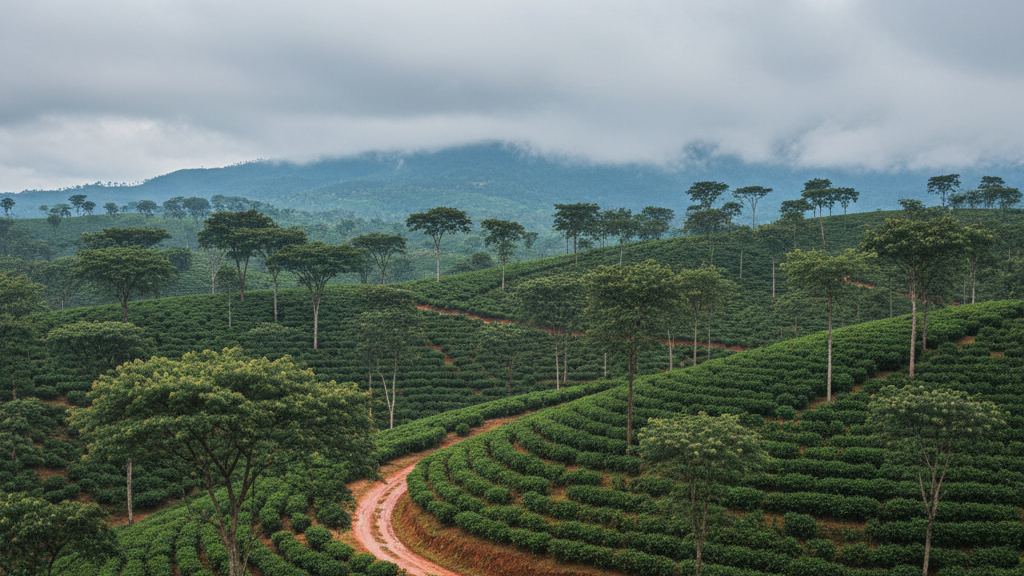
wet stone, drying coffee, fog off the ridge by four
Reserve a stay in the Coorg hills for a week, three weeks or a season
Slow Latitudes reserves one stone house on a working coffee estate in Kodagu, in the hills of southern Karnataka, at three lengths: 7 nights from $2,485 per person, 21 nights, or a season of 56 nights, two people sharing the house. The kitchen cooks for whoever is in it. People take this booking for shade grown coffee country that runs on a crop calendar rather than an opening time, and for a district that still speaks a language of its own at the kitchen table.
Reserve your weeksA reply is written within one business day, by a person.
Reserve a stay in the Coorg hills and what you are given is a single address: a stone bungalow on a working coffee estate in Kodagu, southern Karnataka, two bedrooms, a veranda running the length of the front, and a kitchen with somebody in it from six in the morning. Coffee here is grown under trees rather than out in the open, so what you walk into is not a field but a wood with rows underneath it, silver oak and jackfruit overhead, pepper vines wound up the trunks, and the coffee itself at chest height in the shade.
The length is the first thing we need from you, because up here the length changes what you are buying and not only how much of it. The figure per night comes down as the stay gets longer, and the reason is mechanical rather than generous: a room held for eight weeks is not stripped, cleaned and let again every Saturday, and a kitchen cooking for the same two people for two months orders in a different way from one cooking for a new pair each week. Seven nights works out at $355 a night. Twenty one nights sits a little under $269. Fifty six nights is $212.
The estate is 40 minutes off the main road, six hours from Bengaluru in daylight and about four up from the coast when the ghat road is dry, and it holds one party at a time. Costing the exact weeks you name takes two to four working days, because the estate answers first and it answers around the picking.
A week
7 nights7 nights, from $2,485 per person.about $355 a night
Seven nights gets you one Friday market in Madikeri, one climb up Tadiandamol at 5,735 feet, one run out to the spring above Bhagamandala, and two or three mornings standing in a block while it is hand picked, which is the crop at exactly one stage of its year.
Three weeks
21 nights21 nights, from $5,643 per person.about $269 a night
Fruit that was red on a tree the day you arrived is spread on the drying yard in front of your veranda by the third week, the picking has moved to a different block, and the pepper strings come down off the shade trees while you are still there to see where pepper actually comes from.
A season
56 nights56 nights, from $11,872 per person.about $212 a night
After a month the laundry stops being counted, the man who brings bread up from the village puts two aside for you without being asked, the man weighing the evening baskets hands you the chalk, and you watch one crop go from green fruit through the pulping shed to stacked sacks.
- What this office books
- Slow Latitudes reserves the house, the meals the estate kitchen cooks, and the road transfer at each end of your dates, and it reserves nothing that flies, because nothing that carries a traveller or puts a roof over one is owned at this office.
- Who books it
- Somebody booking this wants to sit still inside one working place long enough that its calendar and not their own decides what happens on a Tuesday.
- Why somebody picks elsewhere
- If you want a different town every three days, or an evening with other people in it, put the money into a coast or a city instead, because this booking will give you neither.
- In the figure
- the stone house with both bedrooms held for every night of your dates, the one item that scales directly with length; three cooked meals a day from the estate kitchen, rice at one and again at eight, which scales with the nights; coffee from the block behind the house, ground the morning you drink it, unmetered at any length; laundry twice a week on the 7 night booking, daily once you pass 21 nights, at no further charge; the road transfer up from the coast or down from Mysuru at the start and end of your dates, one run each way whatever the length; power, water and the generator that carries the house through the monsoon cuts, which does not scale; a walk of the planted blocks with whoever is running the picking that week, once on the 7 night booking and as often as you like across a season; firewood for the veranda stove between November and February; and written confirmation from this office of who to call on the estate if the water stops.
- Not in the figure
- your own round trip flight to southern India, which is never part of a price from here, usually $1,020 to $1,940 per person depending on the month; the estate driver for any day out that is not the arrival or departure run, $38 to $62 a day with fuel; a phone connection of your own, $6 to $16 for a month of data; entry at the temple towns, the falls and the fort, 30 cents to $6 a head; anything bought at the Friday market, which is cash and never billed through us, $10 to $40 a visit; drinks other than coffee, tea and water, $2 to $9 a bottle in the village and more in town; the barber, the tailor and the shoe repair in Madikeri, $1 to $14; coffee, pepper or cardamom shipped home to you, $24 to $70 a parcel; and tips, which the kitchen divides among itself and which nobody here will ask you for.
- Who should not book it
- This is a wet district and the wet is not a detail. From the middle of June to the end of August the light stays grey from breakfast until dark, clothes hung indoors do not dry, leeches come up on the paths, and the power goes often enough that the generator has its own schedule. The nearest town of any size is 40 minutes down a hairpin road, the signal drops in the valley bottoms, and there is no evening to walk out into: dinner is at the house and the house is where you are. Kodava is spoken at the kitchen table and Kannada in the shops, and although the estate works in English, most of what is being said around you is not being said to you and will not be translated. If you need a plan for every day, 56 nights on one estate will be mostly ordinary ones, and the ordinary days are the reason to book it rather than a fault in it.
Each figure is a starting point for two people sharing one room. Costing the exact weeks you name takes two to four working days: the letting company must answer before a number exists, and an air ticket is never folded into one.

What the coffee year does to the house you are sitting in
Nothing on this estate is arranged for looking at, and the year runs on the crop. Arabica is picked by hand from the middle of November to the end of January, and because shade ripens fruit unevenly the same block is gone over four or five times rather than cleared in one pass. Robusta follows into March. What comes off the trees goes to the pulping shed the same evening and then out onto the drying yard in front of the house, where it is raked into lines twice a day and pushed under cover when the sky closes. From the veranda that is a scraping sound at seven in the morning and again at three in the afternoon.
Pepper is picked off the same shade trees from December into February and dries on mats until it rattles. Cardamom sits in the wetter corners of the estate. The small loose skinned oranges the district still grows in patches are on the trees through December, and the ones that reach the kitchen are the ones that fell.
The blossom is the odd event of the year. After the first real rain of March, usually in the last ten days of the month, the hillside flowers white inside about a week and holds it for two or three days. The smell reaches the veranda and then it is finished for another year. The rain decides the date and the estate knows a day or two ahead, which is not enough notice to book a flight around.
Then the rain proper, which owns four months. About 100 inches falls here in a year and two thirds of it comes in June, July and August. In the heaviest fortnight it rains for nine days without a clear hour. The first big rains push bamboo shoot and wild mushrooms into the kitchen for a few weeks and then that is over too. Water in the upper houses is shut off for a couple of hours most afternoons in April. A man brings bread up from the village bakery on a scooter three mornings a week and is done by half past seven. The bus down to the valley floor runs on school days.
- January
- Robusta still coming off the lower blocks, mornings near 57F, and dust off the estate road in everything you own.
- February
- Picking finishes and pruning starts, and the yard fills with pepper drying on mats.
- March
- First thunder, then the blossom, white for two or three days, and the smell of it as far as the veranda.
- April and May
- The hottest weeks, 81F to 84F by two in the afternoon, water off in the upper houses most afternoons, and storms building late.
- June and July
- The heaviest rain of the year, 30 inches or more in July alone, leeches on the paths, bamboo shoot and wild mushrooms in the pot.
- August
- Rain with breaks in it, weeding across the estate, power out often enough that the generator has a routine.
- September
- Kailpodh in the first week, the rain thinning, and the valley road usable again.
- October
- The water at the spring above Bhagamandala comes up in the middle of the month and half the district drives to see it.
- November and December
- Arabica picking starts, Puthari at the full moon, oranges on the trees, and the pulping shed running from first light.

Seven nights, twenty one nights, fifty six
A week is one pass at the place. You get a Friday market in Madikeri, a climb up Tadiandamol at 5,735 feet and about three hours above the road end, a run out to Bhagamandala and the spring on the ridge above it, and two or three mornings out in a block while it is being picked. You see the crop at one stage of its year, whichever stage your dates happened to land on. That is a real thing to have seen and for most people it is the correct amount. You go back down knowing what the shade looks like from underneath it.
Twenty one nights is where the second week stops resembling the first. The picking moves to another block. Fruit that was red on the tree the day you came in is spread out on the drying yard by the time you leave, and you were there for the middle of that, which is the part nobody photographs. Pepper strings come down in what would be your fourth week if you arrived in November. The kitchen stops asking what you would like and starts telling you what there is, which is the better arrangement for everybody. You work out that the bus only goes down on school days, so Sunday is a walking day whether or not you meant it to be, and you work out which of the two shops in the village grinds coffee the way you want it. Three weeks is also long enough to lose four days to rain and not mind.
Fifty six nights is a different purchase and we would rather say so than let you find out. Somewhere in the third or fourth week the estate quietly stops treating you as a visitor. The laundry is no longer counted. The man on the scooter puts two loaves aside without being asked. The man weighing the pickers' baskets at the end of the day will hand you the chalk if you are standing there anyway. You see one crop through from green fruit to stacked sacks. You will pick up perhaps thirty words of Kodava, use most of them wrong, and be corrected at the table by people who find it funny. A road will wash out and you will wait two days for it. The rest of a season is ordinary: reading on a veranda while it rains, walking the same four miles of estate road, rice at one and again at eight.
Season dates fall into two windows and they are not versions of each other. From the first week of November to the last week of December puts you inside the harvest and inside Puthari at the full moon, with dry mornings and a working yard. From the middle of June to the middle of August puts you inside the rain, the green, the mushrooms and the fog, with a stove and a great deal of reading. Pick the one you actually want rather than the one that sounds better written down.
The road up, the bill, and who holds the stay
Slow Latitudes Bookings LLC operates under the name Slow Latitudes. The office is at 9422 Common Street, Suite 2, Baton Rouge, LA 70809, in East Baton Rouge Parish, Louisiana, and nothing that carries a traveller or houses one is owned at that address. What happens here is that we take your dates, put them to the company that runs the estate house and its kitchen, and come back to you in writing with a figure and a list of what it covers. That company holds the stay under a contract of its own and bills you directly for it. This office takes no money from you at any stage, in any form.
You buy the flight. Nothing with wings appears on a price from here, and no part of getting you from the American South to the coast of Karnataka is ours to arrange. Entry paperwork works the same way: it sits between you and the authority that issues it, we do not advise on it, and the length of the stay you choose does not change that.
The road transfer at each end is in the price and is driven by the estate's own man, who has done the ghat for years and will pull over at the top of it if you want to look at what you just came up. Tell bookings@slowlatitudes.com three things: the dates you are considering, the length you want, and how many of you there are. If you would rather say it out loud, call +1 (225) 766-2418. Requests are answered within one business day, and the costed quote follows in two to four working days once the estate has answered. If anything on this page has gone stale or is simply wrong, corrections@slowlatitudes.com reaches the person who fixes it.
Ask this office to reserve your weeks
The form below is open every hour of every day, and what it collects is read by a person, who replies within one business day. Nobody is committed by sending it, nothing is charged for it, and no call or message goes out from here unless you ask for one.