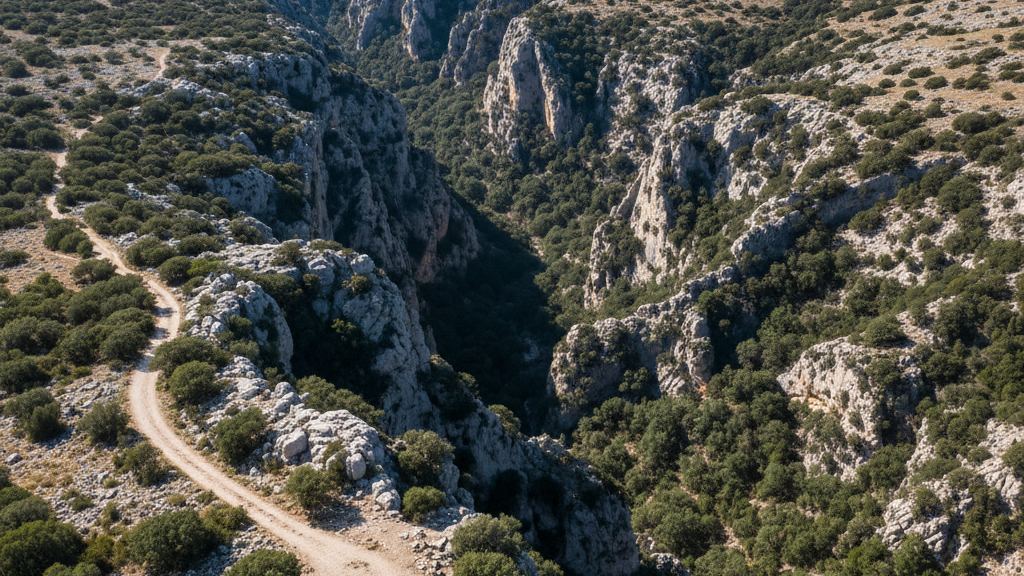
limestone walls, sheep bells before six, bread baked to keep a month
Reserve a stay in Ogliastra, inland Sardinia, for a week, three weeks or a season
Reserve a stay in Ogliastra, the shepherd country of inland Sardinia, for seven nights from $2,384 per person, twenty one nights from $5,187, or fifty six nights from $9,464, on two people sharing. What you are reserving is one valley under standing limestone, at three different depths of familiarity. The week shows you the ground, and the season gives the ground time to get used to you.
Reserve your weeksA reply is written within one business day, by a person.
Reserve a stay in Ogliastra and what you are reserving is one valley, not an itinerary. This is the eastern side of Sardinia, between the Gennargentu massif and about twenty five miles of limestone coast that no road touches. Inland the villages sit between 1,500 and 2,300 feet on a floor of schist, with slabs of pale limestone standing on top of them like blocks somebody set down and left, and the sea is forty minutes below on a road carrying more than sixty hairpins. Slow Latitudes owns none of it. The house belongs to a family, or to a farm that lets one wing and keeps the rest, and whoever runs the weeks is the party that sends you the bill.
The three lengths here are three different purchases, and it is worth being blunt about why. A week is a week of looking, and you will drive most days, because two villages that can see each other across a gorge are often eleven road miles apart. Three weeks puts the car down somewhere in the second week, usually on the morning you work out that the gorge and the coves are behind you and what is left is the village itself. Eight weeks is not a longer version of either one. Eight weeks carries you across a boundary in the year, and the valley in the second half of your stay is doing different work than it was doing on the day you arrived.
The figures are per person on two sharing and they leave out the flight, since the long leg over the water is yours to arrange and airfare is not handled here. The nightly figure comes down as the stay lengthens for a plain mechanical reason: a room let for eight weeks is not stripped, cleaned and turned around every Saturday, and the family letting it is not carrying eight changeover days. Seven nights works out at a little under $341 a night, twenty one nights at $247, and fifty six nights at $169. What each of those buys is set out below, and the difference is not in the room.
A week
7 nights7 nights, from $2,384 per person.about $341 a night
Seven nights gets you one market morning in Lanusei, one descent into the gorge and the climb back out of it, and two or three days at the coves before the paths turn hot at ten.
Three weeks
21 nights21 nights, from $5,187 per person.about $247 a night
By the third week the car sits still for days, the grocery starts holding back the thing you buy every second morning, and you have stood in a cheese room at half past five because somebody asked whether you wanted to see it done.
A season
56 nights56 nights, from $9,464 per person.about $169 a night
After a month the nightly figure stops running in your head and the year takes over the arithmetic instead: you arrive with the shutters shut at noon against 88 F and you leave with the olive nets spread and the flocks back down at village height.
- What this office books
- This office reserves the house and the weeks in it with the family or the farm that owns the building, and it reserves nothing that moves you: not the flight, not the rental car, not the boat passage along the cliff.
- Who books it
- Somebody reserving this is after a place small enough that turning up in the same shop twice changes how the shop deals with you.
- Why somebody picks elsewhere
- If what you want is a paved seafront, a choice of kitchens open after nine at night and a train that runs all year, the flat coast to the north does all three of those and this valley does none of them.
- In the figure
- The let itself, two people sharing, in a stone house, a wing of a working farm or a family pension above the square, held in your name by the family that owns the building, and scaling with the number of nights; linen and towels, turned every Saturday on the seven night let and every second week from the fourth week onward, so the shape of the service changes as well as the quantity; water, power and bottled gas, folded into the figure on the two shorter lets and metered and settled at the end on the season let; wood or pellet for the stove between the first of November and the end of March, scaling with the nights; an arrival hour at the house with the person who keeps the keys, walked through in Italian and in English, which does not scale and is the same on all three lengths; a written page, redone the week you arrive rather than printed once, of which shop opens on which afternoon in your village and which one closes on Wednesday, which also does not scale; the standing order with the bread van, set up in your first week and running to the end of the stay, arranged once whatever the length; notes for the six walks that start on foot from the village, each with the climb in feet and the time up and the time down, which do not scale; one named person here for the whole stay, on <a href="tel:+12257662418" class="lt-tel">+1 (225) 766-2418</a> and in writing at <a href="mailto:bookings@slowlatitudes.com">bookings@slowlatitudes.com</a>, the same on a week as on a season; and one rewrite of your weeks at no charge if your dates move before the operating company confirms them.
- Not in the figure
- The flight, which is yours to book, roughly $920 to $1,780 round trip per person out of the American South in the shoulder months and higher through July and August; a rental car, about $340 to $520 a week for a small manual in May and about $610 to $880 in August, taken on the rental company's own contract with you and not through this office; fuel, running about $7.10 to $7.60 for the equivalent of a gallon, and the hairpins drink it; food, about $85 to $140 a week for two out of the village shops, and about $34 to $55 for two on a set menu in a village kitchen; the boat passage along the cliff to the coves, which the licensed boatman holds under his own permit and bills you for on the quay, about $32 to $58 per person; the charge taken at the trailhead of the walked cove by the municipality that caps the daily numbers, about $6 to $8 per person on the days it is collected; guided entry to the show cave at Ulassai, about $14 to $18 per person, and it is closed for part of the year; the summer narrow gauge service through the interior, about $16 to $30 per person for a return leg, running roughly mid June to mid September and not on every day; laundry beyond what the house turns, about $9 to $16 a load at the village machine on the season let; and anything to do with entry rules, which sit between you and the authority that issues them and on which nothing is offered here by way of guidance.
- Who should not book it
- Do not reserve this if you need to be twenty minutes from a supermarket, a bank machine and a road without hairpins, because you will be an hour from all three of them. Almost nobody in the upper villages speaks English, and the Italian spoken between two people who grew up in the same street here is not the Italian anybody teaches; you will be spoken to slowly and you will still lose half of it. The houses are stone and they are cold from November, and in a valley that takes forty eight inches of rain across the year the damp gets into cupboards, into books and into boots. A season in a village of eleven hundred people is mostly ordinary days, and you will spend a great many afternoons reading; if that reads to you as the trip failing rather than as the point of it, reserve the week.
Each figure is a starting point for two people sharing one room. Costing the exact weeks you name takes two to four working days: the letting company must answer before a number exists, and an air ticket is never folded into one.
The ground between the massif and the wall
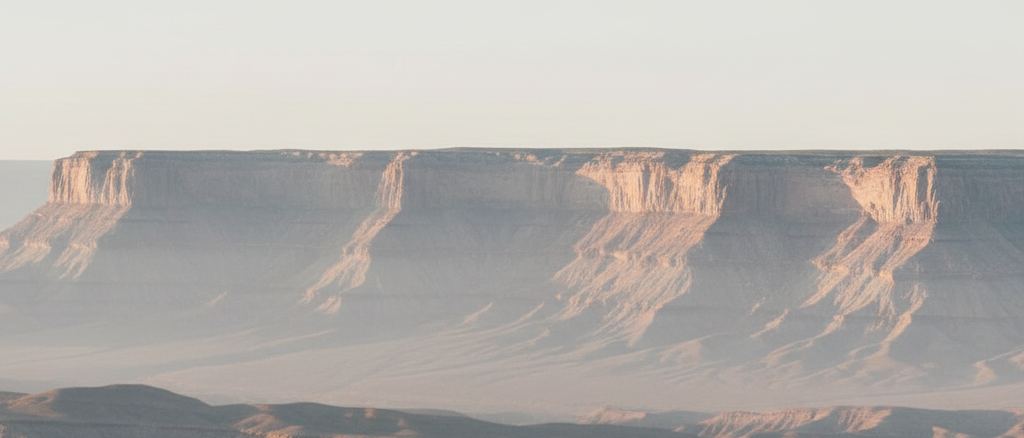
Nothing about this landscape is gradual. The schist underneath is old and rounded and carries the villages, and the limestone on top of it broke into separate towers, so flat topped blocks stand alone above Ulassai, Gairo and Osini with two hundred foot faces and grass on their tops. The gorge cuts north of the villages and you come at it from a pass on the old coast road at 3,337 feet, dropping about 1,900 feet through holm oak to a floor of white boulders where the walls close to about a hundred feet apart and stand four hundred above you. The descent takes most people an hour and a half, the climb out two and a half, and longer in September when the floor still holds the afternoon at 84 F.
Above the village of Baunei a road leaves the main street and gains 1,300 feet in three and a half miles of switchbacks onto a plateau at about 2,130 feet, where the ground goes suddenly level, the donkeys are loose and unbothered, and a limestone shaft opens a hundred yards off the verge and drops about 890 feet. From the far edge a path drops to the coves in a little over an hour and comes back up in nearer two, and the municipality caps how many walk in on a given day and takes a small charge at the trailhead. Griffon vultures work the updraft along the cliff most mornings from about nine, close enough that you hear the air over the feathers.
Weeks two and three, when the car stops moving
The first week is spent covering ground. In the second week something shifts, and it is not romantic, it is logistical. You learn that the grocery shuts at one and does not open again on Wednesday afternoon at all, that the single fuel pump is closed Sunday, and that the van bringing bread up from the bakery on the valley floor reaches the upper hamlets on Tuesday, Thursday and Saturday at about a quarter past seven and is gone in four minutes. Once you know those three things you stop planning days and start having them.
By the third week you are recognized, and recognition here has a specific texture. The woman in the grocery starts putting aside the sheep ricotta she knows you take, because it is made that morning and it is gone by ten. The man who keeps two hundred ewes on the slope above the road stops nodding and starts asking questions, and one of them will eventually be whether you want to come down at half past five and watch the milk go into the vat and come out an hour later as something you can hold. None of it can be arranged in advance and none of it happens in seven nights. It happens because you were there on an ordinary Tuesday with nothing to do.
Three weeks in September also puts you inside the grape pick. From about the twentieth the roads carry tractors and trailered bins, the growers' cooperative on the edge of Jerzu runs late, and everybody who was free in the first week of your stay is unavailable in the third. That is worth knowing before you reserve those dates rather than after. Three weeks from the middle of May does the opposite: it puts you in the fortnight when the flocks go up, cheese is made every morning, and the hairpins carry stock lorries at first light.
- January
- More than five inches of rain on the high villages, cloud sitting at 2,000 feet for days, and bonfires in the squares on the sixteenth and seventeenth.
- March
- Blossom finished by the twentieth, mains water running full, and the tracks above 4,000 feet still soft with snowmelt.
- May
- Flocks move up, cheese made every morning, stock lorries on the hairpins before six.
- June
- Fourteen and a half hours of daylight by the twentieth, coves filling after ten in the morning, the summer narrow gauge service starting on a few days a week.
- July
- About 90 F on the coast and 82 F at village height, and the mains in the upper hamlets cut for two hours most afternoons.
- August
- Shut and full at the same time around the fifteenth, sea at about 77 F, flatbread baked twice a week instead of daily.
- September
- Grapes from the twentieth, tractors owning the road for ten days, and the village that ignored you in August asking where you are staying.
- November
- Olives, nine and a half hours of daylight, the coves empty, and the pass road closed on the mornings it ices.
Eight weeks, and what a season actually does
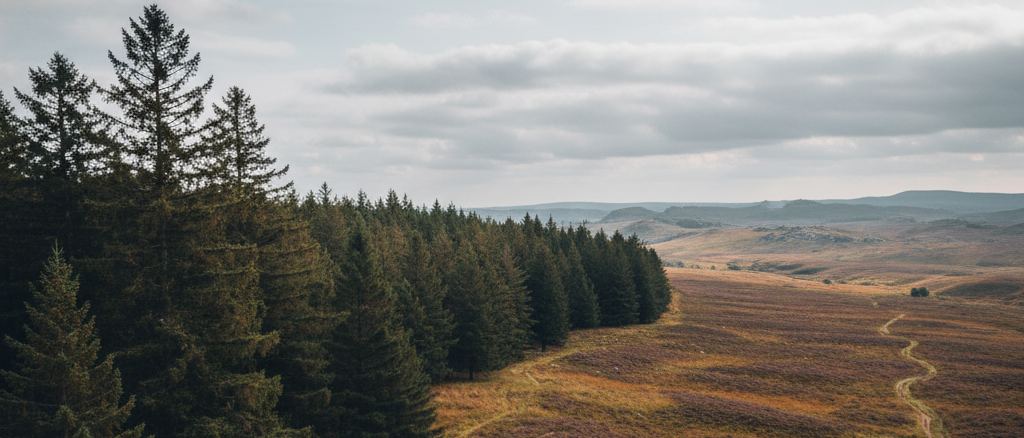
Fifty six nights is the length at which the calendar stops being your calendar. Book it from the first week of September and you arrive in heat, with the shutters shut from noon to four and the village dead until six, and you leave in the first week of November with the nets down under the olives, the flocks back at village height, and the light gone by half past five. Nothing in the middle of that is dramatic. The point is that you are present for a change the place makes to itself, rather than arriving inside one state of it and leaving inside the same state.
Practical things change too, and they change in the fourth week, not the second. The linen goes from every Saturday to every second week, because nobody cleans a room that is not being re-let, and the laundry done in the machine downstairs stops appearing on the account, on the reasoning that you are less a guest now than a person in the house. The bus that only runs on school days, and the show cave at Ulassai closing for part of the year, stop being obstacles and become the shape of the week. And somewhere in the fifth or sixth week the tracks over the shoulder at 4,000 feet dry out or freeze, depending on which direction the season is going, and the walking you can do changes entirely.
One thing eight weeks gives is hard to state without overclaiming, so here it is plainly. In a village of eleven hundred people, a week makes you a visitor and two months makes you a fact. Somebody expects you. Whether that is worth $9,464 and two months of ordinary afternoons is a question only you can answer.
How a reservation is put together here
Slow Latitudes is a small independent booking office run from 9422 Common Street, Suite 2 in Baton Rouge, East Baton Rouge, Louisiana. The office holds title to no beds, no vehicles and no berths of its own, and it takes no payment of any kind: no deposit, no card, no balance. You tell us the weeks you want and how many of you there are, we place the request with the company that actually runs the stay, and that company confirms and bills you directly under its own terms.
A price written against your own weeks, rather than the figures on this page, comes back in two to four working days, because somebody has to ask a family in a village whether the house is free in that fortnight, and villages answer at their own pace. Send the request through the form below, write to bookings@slowlatitudes.com, or call +1 (225) 766-2418. Corrections after the operating company confirms go to corrections@slowlatitudes.com. Slow Latitudes Bookings LLC is registered in LA, at the 70809 address above.
Two limits, stated once. The flight is not ours: we do not sell, hold or arrange air travel, and the passage along the cliff belongs to the boatman licensed for it, who bills you on the quay. Entry rules are between you and the authority that issues them, and this office does not advise on them at any length of stay.
Ask this office to reserve your weeks
The form below is open every hour of every day, and what it collects is read by a person, who replies within one business day. Nobody is committed by sending it, nothing is charged for it, and no call or message goes out from here unless you ask for one.